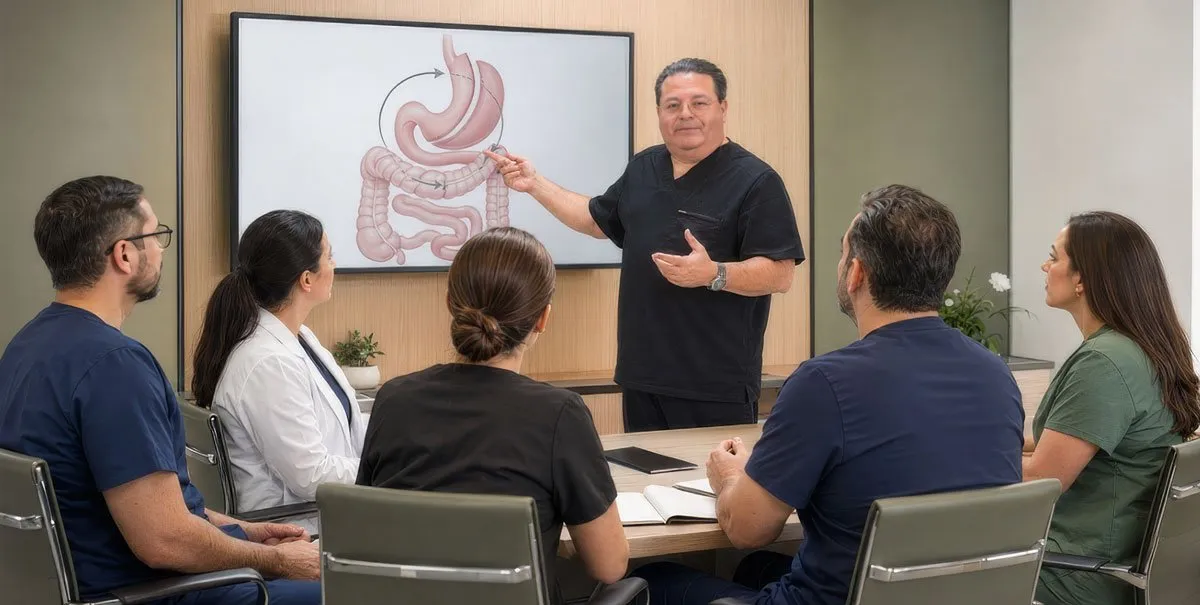
What the duodenal switch changes
A duodenal switch pairs a sleeve-shaped stomach with an intestinal bypass that is longer than a standard Roux-en-Y. The surgeon divides the duodenum just beyond the stomach and connects it to a limb of small intestine. Bile and pancreatic juice travel in a separate limb and meet the food in a short common channel. Less of the intestine touches the meal, so absorption of calories, fat, and some vitamins falls. That is the point of the operation, and it is also the source of its stricter diet.
This page does not publish a package price. Limb lengths are chosen for the person in the operating room. They are not a recipe a reader can copy, and this page does not promise a named variant such as a single-anastomosis reconstruction. The stomach portion resembles a sleeve, but the intestinal portion is what makes the consent different. Protein, fat-soluble vitamins, and bowel habit have to be discussed before anyone treats this as a simple sleeve with an extra step.
Who may be considered
The switch is usually considered when the record shows a very high body mass, a previous sleeve that is being reconsidered, or a metabolic disease that a simpler operation may not address. Those are review questions, not acceptance rules printed as numbers. A person who already struggles to take vitamins every day is a weak candidate, because the malabsorptive limb punishes missed doses. The quiz cannot see that habit. The medication list and a direct question can.
There is no deposit to apply. There is also no published dollar price to compare against the sleeve package. If the review finds that a sleeve or a Roux-en-Y is the safer operation, that is an acceptable outcome. Pregnancy plans, inflammatory bowel disease, and prior intestinal surgery change the anatomy that can be used. Dr. Sergio Quiñones reads those facts before a date is discussed.
How the operation is done
The usual approach is laparoscopic. The stomach is reduced along its outer curve, in a way a patient will recognize from sleeve descriptions. The duodenum is then divided and the intestine is arranged so food and bile meet late. Both joins are checked. A leak test may be used. Scar tissue or a very large liver can change the order of steps. This page does not publish a minute count, because the procedure record does not contain one.
The common channel must stay long enough for the person to absorb protein and vitamins, and short enough for the operation to do what it was chosen to do. That balance is a surgical judgment recorded in the note. It is not a public centimeter count. The pre-operative diet is still required so the liver does not block the view. Walking and liquids start on the hospital schedule the team assigns, the same way they do after the other operations, with a tighter vitamin plan afterward.
Risks discussed before travel
Bleeding and leak remain early risks at the stomach staple line and at the intestinal joins. The later risks that define this operation are loose stools, gas, kidney stones, and deficiencies of protein and of vitamins A, D, E, and K, along with iron, calcium, and B12. Bone health and night vision are examples of why those vitamins are not optional. Complication insurance is explained from a certificate when a package is quoted. This page does not name an insurer or a maximum payout.
A blockage at a join, a twist of intestine, and the need for a later revision of limb lengths are part of the consent. Weight change is not stated as a percentage. Death under anesthesia is rare and is named. Someone who chooses a switch only because they heard it causes the most weight loss is hearing a slogan, not a plan. The plan is the vitamin burden and the bowel change, accepted in writing, or a different operation.
How the switch differs from a sleeve or a bypass
A sleeve stops at the stomach. A Roux-en-Y bypass reroutes food with less intestinal bypass than a switch. A mini bypass uses one loop and raises a bile-reflux question this operation answers differently, because bile meets food in a short common channel rather than washing back into a pouch. Revision surgery may convert an older operation, and its $5,800 USD package is subject to medical evaluation, whereas a duodenal switch is quoted only after record review. None of these pages should be read as a menu with a single price.
If a switch is chosen, the coordinator's quote is the first time a dollar amount appears. Until then the public facts are the anatomy, the vitamin duty, the address for travel in Zona Río, and the zero deposit to be reviewed. Dr. Q. Surgical Center does not print an expected loss percentage for the switch. It also does not attach an accreditation name to the hospital.
Eating before surgery
In the weeks before surgery, many patients follow a high-protein, low-carbohydrate diet so the liver is smaller and the upper stomach is easier to see. The exact menu is written after the record is reviewed. It is not the same sheet for every person. People with diabetes may need a change in glucose medicine during this diet, and that change is made by the clinician who already prescribes it, together with the surgical plan. A patient does not stop a prescribed drug because a webpage said so.
The usual targets are steady protein, fewer sugary drinks, and no alcohol. Carbonated drinks are stopped because gas is uncomfortable after stomach surgery. Smoking and nicotine products are a separate risk for healing, and the team asks about them directly. Blood thinners, anti-inflammatory pills, and herbal products are listed by name so the surgeon can say which ones pause and when they restart. The application itself does not require a deposit while this list is being collected.
Eating after surgery
After the operation, the stomach needs time before solid food is safe. The first phase is clear liquids: water, broth, and sugar-free gelatin, in small sips. The next phase adds protein shakes and other full liquids if they are tolerated. Pureed food comes later, then soft food, then a regular texture in small portions. The day each phase starts is assigned by the team. This page does not publish a personal day count as if it were a promise.
Protein is the nutrient people most often miss. A shake or another protein source is part of the early plan, and the amount is written for that person. Vomiting, dizziness, or an inability to drink is a reason to call, not a reason to push the next phase. Vitamins are added when the surgeon says the stomach will tolerate them. The five-year nutrition follow-up included with priced packages is the place where those doses are adjusted. A blog schedule from another clinic is not the Dr. Q. Surgical Center plan.
The days in Tijuana
Patients who fly into San Diego International Airport are met for the private transfer into Tijuana. The package that has a published price includes that round trip. The address used for the stay is Av. Diego Rivera 2550 in Zona Río. A companion can travel with the patient. The coordinator sets the pickup time after the surgery date is confirmed, and the patient keeps the passport and the medicine list in a carry-on bag.
The hospital portion is a short stay for walking, liquids, and pain control. Nurses help the patient sit up and walk on the day of surgery when the anesthesiologist agrees. The recovery suite comes after that hospital portion. This page does not name a hospital and does not describe an accreditation, because that document is not part of the public file. Questions about the room, the companion bed, and the ride back to San Diego are answered by the coordinator before tickets are bought.
The package and the five-year follow-up
This operation does not have a published package price. A written quote follows the record review. Where a price is published, it covers the surgeon, the hospital stay, the recovery suite, private transport from San Diego, and complication insurance. It does not cover a personal airline ticket. Applying to be reviewed costs a $0 deposit. If the surgeon does not clear the person, the trip is not treated as a booked surgery. The insurance is described as included. This page does not name an insurer, a dollar cap, or a list of exclusions. Those terms are explained from the certificate before travel.
After the return home, priced packages include nutrition follow-up for five years. The contact is for diet stages, vitamins, and symptoms that need a surgeon's eye. It is not a substitute for emergency care in the patient's own city. Chest pain, fainting, uncontrolled vomiting, or a fever is a reason to use local emergency services and then call the Dr. Q. Surgical Center number. The phone published on this site is +1 (858) 439-7931. Dr. Sergio Quiñones remains the reviewing surgeon named on the plan.
| Checkpoint | What is reviewed | What the patient does |
|---|---|---|
| Before travel | Vitamin habit, bowel disease, prior surgery | Sends records and applies with no deposit |
| Clearance | Whether a short common channel is safe | Waits for a written quote |
| Hospital days | Joins, liquids, walking | Starts only the phase assigned |
| At home | Protein, vitamins A D E K, stools | Keeps lab follow-up the team orders |